
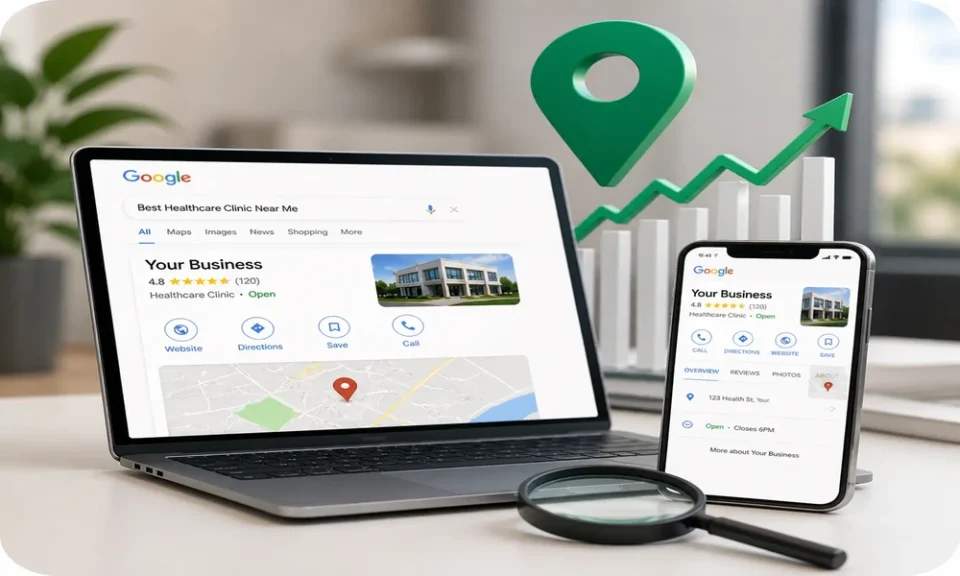
Imagine a patient in your city searching for “best dermatologist near me” or “child specialist clinic open now.” Google Maps populates three results, the patient picks one, and books an appointment, all within minutes. The question is: is your clinic showing up in those results?
If the answer is no, you are leaving a significant number of patients, and revenue, on the table. Healthcare Local SEO Services have become one of the most powerful tools for clinics and hospitals looking to grow their patient base without relying entirely on expensive paid ads. This guide walks you through exactly what it takes to rank your clinic on Google Maps and turn local searches into real appointments.
Why Google Maps Visibility Is a Game Changer for Clinics
Before diving into strategies, it is worth understanding why Google Maps rankings matter so much for healthcare providers.
When someone searches for a nearby clinic or doctor, Google displays what is called the “Local Pack,” a set of three business listings that appear at the very top of the search results, above organic website links. Appearing here means massive visibility, high trust, and direct access to patients who are actively looking for care right now.
The Patient Behaviour Shift You Cannot Ignore
Studies consistently show that over 70% of patients search online before choosing a healthcare provider. A significant portion of those searches happen on mobile devices, where Google Maps is the default navigation to a decision. If your clinic does not appear in local search results, a competitor’s clinic will.
Step 1: Claim and Fully Optimise Your Google Business Profile
Your Google Business Profile (formerly Google My Business) is the foundation of your local search presence. Think of it as your clinic’s digital front desk.
What to Do Right Now
- Claim your listing if you have not already done so at business.google.com.
- Fill every section completely: clinic name, address, phone number, website, working hours, and holiday hours.
- Choose the right primary category (for example, “Oncologist,” “Paediatrician,” or “Multispeciality Clinic”) because this directly influences which searches trigger your listing.
- Add high-quality photos of your clinic exterior, reception, consultation rooms, and your team. Listings with photos receive significantly more clicks.
- Write a keyword-rich business description that naturally mentions your speciality and location without sounding robotic.
A complete, accurate, and visually appealing profile signals to Google that your clinic is legitimate, active, and worth showing to local searchers.
Step 2: Build Consistent NAP Citations Across the Web
NAP stands for Name, Address, and Phone Number. Google cross-references your clinic’s information across dozens of online directories to verify its legitimacy. Any inconsistency, even a slight variation in your address format, can confuse Google’s algorithm and hurt your rankings.
Where Your Clinic Should Be Listed
- Practo, Justdial, Sulekha, and IndiaMART (for Indian clinics)
- Healthgrades and WebMD (for broader visibility)
- Local business directories and chamber of commerce listings
- Your hospital or clinic network’s website
Make sure the name, address, and phone number are identical across every single platform. This consistency builds what SEO professionals call “citation authority,” one of the key ranking signals Google uses for local results.
Step 3: Generate and Manage Patient Reviews Actively
Reviews are one of the single most powerful ranking factors in Google Maps. More importantly, they are what convert a searcher into a patient.
How to Get More Reviews Without Being Pushy
- Ask at the right moment: After a successful consultation, a staff member can simply say, “We would love your feedback on Google, it really helps other patients find us.”
- Send a follow-up WhatsApp or SMS with a direct link to your Google review page
- Make it easy: A QR code at reception linking directly to your review form removes all friction
Responding to Reviews Matters Too
Always respond to reviews, both positive and negative. Thank patients who leave kind words, and address concerns raised in negative reviews professionally and empathetically. Google rewards active, responsive businesses with better visibility.
Step 4: Optimise Your Clinic Website for Local Search
Your website and your Google Business Profile work together. A well-optimised website reinforces your local authority and sends strong ranking signals to Google.
Key Website Optimisation Checklist
- Include your city and speciality in your page titles and headings (for example, “Thyroid Cancer Specialist in Mumbai”)
- Create a dedicated contact page with your full address, embedded Google Map, and local phone number.
- Add schema markup (LocalBusiness and MedicalOrganization schema) to help Google understand your clinic’s details.
- Ensure your website loads fast on mobile, since most local searches happen on smartphones.
- Create locally relevant blog content that answers common patient questions in your city.
This is where Local SEO for clinics goes beyond just Google Maps and becomes a full digital strategy that drives sustained, long-term patient traffic.
Step 5: Use Google Posts to Stay Active and Relevant
Many clinic owners set up their Google Business Profile and never touch it again. That is a missed opportunity.
Google Posts allow you to share updates, health tips, offers, and announcements directly on your listing. Clinics that post regularly signal to Google that they are active businesses, which positively influences rankings. Aim for at least two posts per week, whether it is a health awareness tip, a new service, or a seasonal health reminder.
Step 6: Leverage Local Backlinks for Stronger Authority
Backlinks, which are links from other websites pointing to yours, remain a significant ranking factor. For clinics, the most valuable backlinks come from locally relevant and medically credible sources.
Where to Earn Local Backlinks
- Guest posts on local health blogs or city-based lifestyle websites
- Features in local news articles or health columns
- Partnerships with nearby pharmacies, diagnostic labs, or wellness centres
- Listings on medical association websites
Even a handful of high-quality local backlinks can give your clinic a meaningful edge over competitors in your area.
What Healthus.ai Does Differently
Ranking on Google Maps requires consistent effort, technical know-how, and a deep understanding of how healthcare patients search and decide. Healthus.ai is a dedicated healthcare digital marketing agency that combines medical industry knowledge with proven local SEO strategies to help clinics, hospitals, and specialists grow their local patient base organically.
From Google Business Profile optimization to citation building, review management, and locally targeted content, Healthus.ai handles the digital side so that you can focus entirely on patient care.
Your Roadmap to More Local Patients: Final Thoughts
Ranking your clinic on Google Maps is not a one-time task. It is an ongoing process that rewards consistency, accuracy, and genuine patient engagement. Here is what to take away from this guide:
- Your Google Business Profile is your most important local asset, keep it complete, accurate, and updated.
- Consistent NAP information across directories builds the citation authority Google needs to trust your listing.
- Patient reviews are both a ranking factor and a conversion tool, actively encourage and respond to them.
- Your website and Google listing must work together for maximum local visibility.
- Local SEO for clinics is a long-term strategy, but the compounding results, more visibility, more trust, more appointments, make it one of the highest-return investments a clinic can make.
- Staying active on your listing with posts, photos, and responses signals to Google that your clinic is the real deal.
The patients are already searching. The only question is whether they are finding you or your competitor.
Frequently Asked Questions (FAQs)
Q1. How long does it take to rank a clinic on Google Maps?
Results vary depending on your location, competition, and how well your profile and website are optimised. Most clinics begin seeing noticeable improvements within 60 to 90 days of consistent effort. Highly competitive cities may take longer, but the results are sustainable.
Q2. Do I need a website to rank on Google Maps?
Technically, no. You can rank on Google Maps with just a Google Business Profile. However, having a well-optimised website significantly strengthens your local authority and helps you rank higher and faster. It also gives patients a place to learn more before booking.
Q3. How many Google reviews does my clinic need to rank well?
There is no fixed number, but quality and recency matter as much as quantity. A clinic with 40 recent, genuine 4 to 5 star reviews will often outrank one with 200 older reviews. Focus on a steady stream of authentic reviews rather than a one-time burst.
Q4. Can a small single-doctor clinic compete with large hospitals on Google Maps? Absolutely. Google Maps rankings favour relevance and proximity over size. A well-optimised single-doctor clinic with strong reviews and accurate local information can rank above a large hospital for highly specific searches in a particular neighbourhood.
Q5. What makes Healthus.ai different from a general digital marketing agency? Healthus.ai focuses exclusively on the healthcare sector. This means they understand patient search behaviour, medical compliance requirements, and the specific trust signals that matter in healthcare marketing. Their strategies are built specifically for clinics, hospitals, and specialists, not adapted from generic business templates.
