
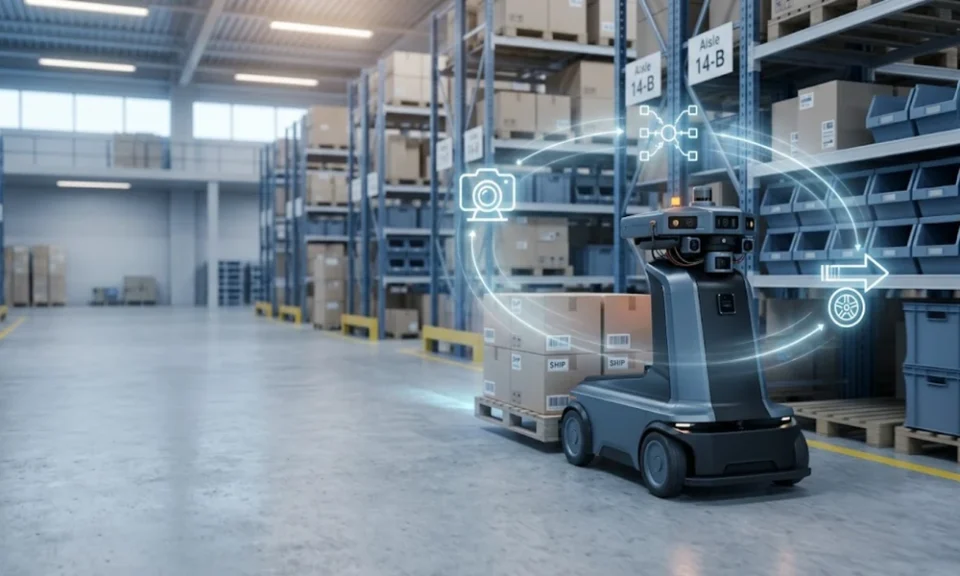
What embodied intelligence really is, where it already earns its keep, and the one thing every working system depends on.
| TL;DR Physical AI is the branch of artificial intelligence that works in the real world. It runs machines that read their surroundings, move through space, and act on decisions with barely any human input. Every warehouse robot and self-driving prototype rests on one thing most people overlook: huge volumes of high-quality, real-world training data. Thin or fake data is exactly why most systems stall before they ship. This guide shows how physical AI works, where it already pays off, and how Humyn Labs closes the data gap that holds these systems back. |
| What is physical AI? Physical AI is artificial intelligence built into machines that sense their environment through cameras and sensors, process that input to make decisions, then take physical action in the real world. Unlike software-only AI, it ties digital reasoning to mechanical motion. It powers robots, self-driving vehicles, drones, and factory automation. |
The gap nobody warns you about
You pour budget into AI that lives on a screen. It writes, it answers, it sorts. Then the work needs hands, wheels, or eyes, and the whole thing hits a wall. That wall has a name. It marks the line between digital AI and the physical world.
Physical AI crosses that line. People also call it embodied AI or embodied intelligence, and the terms get used side by side. The idea holds steady. You give a machine the power to read its surroundings, choose what to do, then actually do it.
I have watched teams burn months here. They train a model in a clean simulation, the demo looks sharp, and then the robot meets a real loading dock with bad light, odd angles, and a pallet nobody labeled. The model freezes. The algorithm was never the problem. The data underneath it was.
So what separates a slick demo from a robot that survives the real world? This guide answers that. It is written for operations leaders, product owners, robotics builders, and curious readers who want the honest picture. You will learn what physical AI is, how it works, where it already makes money, and how to start without setting cash on fire.
What is physical AI, in plain words
Physical AI means intelligence that acts in the material world. A model takes in what its sensors report, works out a response, then drives motors to carry it out. The output is not a sentence on a screen. It is a movement, a grip, a turn, a stop.
Picture the difference. A chatbot reads text and writes text. Nothing moves. Embodied AI reads the world and changes it. A collaborative robot eases its grip on a fragile part. A mobile robot reroutes around a person who just stepped into the aisle. Those are consequences you can touch.
And it beats plain automation. A factory arm that repeats one fixed motion is automation, and it cannot adapt. Physical AI adapts. It handles the object it has never seen and the corner case nobody scripted. That flexibility is the entire point.
How physical AI works: the sense, decide, act loop
Every physical AI system runs one loop, over and over, many times a second. Sense. Decide. Act. Then it checks the result and goes again.
Sense: reading the real world
The machine pulls raw signal from its sensors. Cameras give it sight. Radar measures distance and speed. Lidar maps shape in three dimensions. IMU sensors track motion and orientation. Microphones catch sound. Tactile sensors feel pressure.
On its own, this stream is noise. The system has to fuse these inputs into one clear picture of the scene. That step, sensor fusion, quietly sinks a lot of projects, because syncing many devices in the messy real world is hard.
Decide: turning perception into a plan
Next the model reasons. It classifies what it sees, predicts what happens next, and picks an action. Modern systems lean on computer vision, which now holds the largest slice of physical AI technology spend, and on reinforcement learning for control. The catch is time. These decisions often run on the device itself, at the edge, in milliseconds, because a robot cannot wait on a distant server.
Act: doing the thing
Then the system moves. Motors, actuators, and grippers carry out the plan. Sensors watch the outcome, feed it back, and the loop corrects. Over many cycles the system learns what works. This feedback is the heart of embodied intelligence. You can go deeper on the training side in this guide to world models and how AI learns to simulate reality.
The numbers behind the hype
Before we go further, here is why this matters now and not in five years. The money tells the story, and it points one way only.
- One widely cited forecast puts the physical AI market near 81 billion dollars in 2025, on a path past 1 trillion dollars by 2035 at roughly 33 percent yearly growth.
- Robotics investment jumped about 300 percent in the fourth quarter of 2025 alone.
- Goldman Sachs projects cumulative humanoid robot investment above 50 billion dollars by 2030.
- At CES 2025, Jensen Huang said physical AI had reached its ChatGPT moment. In January 2026, Boston Dynamics and Google DeepMind put Gemini Robotics models on the electric Atlas humanoid and sent fleets to Hyundai sites.
Hardware leads spend today, around 56 percent, because sensors, actuators, and AI chips form the body of every system. Software climbs fastest. North America holds the largest share, while Asia Pacific grows quickest, pulled by China, Japan, South Korea, and a fast-moving Indian logistics sector.
The hidden engine: why physical AI lives or dies on data
Now the part the glossy demos skip. Physical AI succeeds or fails on the data it learned from. Not the model. The data.
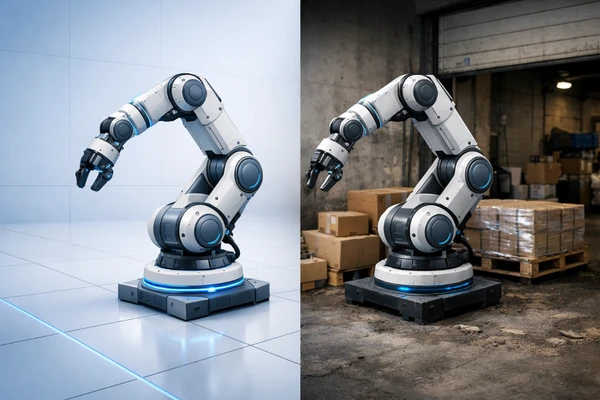
Teams reach for simulation first, and they should. It is cheap and fast. But the sim-to-real gap is brutal. Synthetic worlds miss edge cases, rare events, and the plain weirdness of real physics. A model trained only in sim looks great until reality hands it something the simulator never dreamed up. Then it breaks, and in safety-critical work that break costs a fortune.
The fix is real-world data. Diverse, accurately labeled, captured in the actual environments your model will face. Camera feeds, radar returns, IMU readings, robotic manipulation runs, all synced and verified. The Humyn Labs guide to training data for robotics says it straight: the sim-to-real gap is a data problem before it is anything else.
| Where Humyn Labs fits Most vendors only label data you already have. Humyn Labs handles the whole job, from real-world collection to multi-sensor annotation. Verified field teams capture data in the environments your model needs. Domain experts with real autonomy and robotics experience label it with 3D boxes, segmentation, tracking, and scene tags. Every dataset passes multi-layer quality control before it reaches you, delivered in KITTI, nuScenes, or your own format with full provenance. |
Where physical AI already works
This is not a someday technology. Physical AI earns money on real floors right now. A few proven areas:
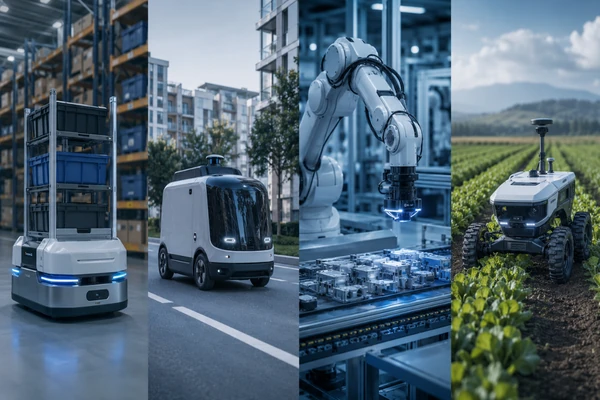
- Warehouses and fulfillment. Mobile robots pick, sort, and move stock around the clock. Agility Robotics’ Digit already works inside Amazon facilities.
- Autonomous vehicles and delivery. Self-driving systems and delivery bots read traffic, pedestrians, and weather, then act in real time.
- Manufacturing and inspection. AI vision systems catch defects a human eye misses, and adaptive robots adjust to new product designs on the same line.
- Healthcare and assistance. Surgical systems correct for patient motion mid-procedure, and assistive robots support care work. Healthcare is the fastest-growing application segment.
- Agriculture. Field robots scout crops, target weeds, and harvest, cutting chemical use and labor strain.
Robot manipulation sits under many of these. Want the mechanics? Read what robot manipulation is and the data behind it.
What physical AI does for your business
Strip away the buzz and the case is simple. Here is the what’s-in-it-for-me, stated plain:
- Lower running costs. Machines work nights, weekends, and holidays without overtime.
- Safer work. Robots take the dangerous, repetitive, body-wrecking tasks off your people.
- Steadier output. A trained system holds quality and pace that human fatigue cannot match.
- Scale without a hiring scramble. You add capacity by adding machines.
- An early-mover edge. The data you collect now compounds. Competitors who wait start years behind.
What it means for people and jobs
The fear is real, so let’s be honest. Physical AI shifts work. It does not erase it. New roles open in robot oversight, data annotation, and system training. Strain and injury drop when machines take the brutal tasks. And the people who learn to train and supervise these systems move into steadier, better work. Humyn Labs proves the point. Its annotation and collection work runs on verified human experts, not anonymous crowds.
The real barriers, and how to clear them
Plenty of physical AI projects stall. The reasons repeat, and so do the fixes.
Barrier 1: thin or low-quality data
This is the top killer. A model starved of real-world examples fails on real-world inputs. The fix is to source representative, well-labeled data for your exact task before you scale. That is the gap Humyn Labs physical AI data services exists to close.
Barrier 2: hardware and integration cost
Robots and sensors run expensive. Start with one high-value task, prove the return, then expand. Do not boil the ocean.
Barrier 3: safety and reliability
For anything safety-critical, you need defensible data and tested behavior. That means multi-layer quality control and, for the riskiest work, a domain-expert review layer on every dataset.
How to get started: a practical roadmap
- Pick one task. Choose a single high-friction physical job worth automating. Just one.
- Audit your data. Look at the sensor and operational data you already hold, and where the holes sit.
- Source quality training data. Commission real-world, labeled data for that task. This step decides everything downstream.
- Pilot and measure. Run a controlled test. Track results against a clear baseline before any rollout.
- Build a feedback loop. Feed real outcomes back into the system so it keeps improving after launch.
New to model training end to end? The Humyn Labs step-by-step guide to training an AI model walks the full path, and reminds you that data prep eats about 80 percent of the work.
What comes next
Three shifts are already underway. General-purpose humanoid robots are leaving labs for warehouse floors. Multimodal models now blend vision, language, and motion in one system, so a robot can take a spoken instruction and act on it. And robotic foundation models, pretrained on huge diverse datasets, let machines generalize to objects and rooms they have never seen.
One thread runs through all of it. The data foundation you build today decides who leads tomorrow. The teams collecting clean, verified, real-world data right now will ship reliable physical AI first.
Why the data partner you pick matters
Many data vendors run on anonymous crowds, loose standards, and zero traceability. For physical AI, that is a real risk. You cannot defend a safety-critical model on data you cannot trace. Humyn Labs took the opposite path. Every contributor is a verified expert with an on-chain reputation. Every workflow is auditable. Every dataset is double-checked, peer review plus centralized quality control. For a young robotics team, that traceability is the difference between a model you can stand behind and one you only hope works.
Frequently asked questions
What is physical AI in simple terms?
Physical AI is AI that lives inside machines and acts in the real world. It senses its surroundings, decides what to do, and moves to do it. Robots, self-driving cars, and drones all run on it.
How is physical AI different from generative AI?
Generative AI produces information, like text or images on a screen. Physical AI produces action in the material world, like a robot gripping a part or a vehicle changing lanes. One writes. The other moves.
What industries use physical AI today?
Manufacturing, warehousing and logistics, automotive and self-driving, healthcare, and agriculture all use it now. Manufacturing and automotive lead on revenue. Healthcare grows fastest.
Why is training data so important for physical AI?
Models fail in the real world when they train on thin or synthetic data. Real-world, labeled training data closes the sim-to-real gap and gives a system the reliability it needs to deploy safely.
Is physical AI the same as robotics?
Not quite. Robotics is the hardware and mechanics. Physical AI is the intelligence that lets that hardware perceive, decide, and adapt. A robot without physical AI just repeats fixed motions.
How does Humyn Labs help with physical AI data?
Humyn Labs collects and annotates multi-sensor real-world datasets, camera, radar, and IMU, in the environments where simulation falls short. Verified domain experts label the data, and multi-layer quality control checks every set before delivery.
The bottom line
Physical AI is moving from novelty to necessity. The machines that win are not the ones with the flashiest demo. They are the ones built on real, well-labeled, real-world data. Remember the loading dock that froze the model at the start. That was a data failure, and data failures get fixed.
Start small. Pick one task, secure the right data, prove the return, then scale. And when you need real-world collection and annotation you can defend, talk to Humyn Labs. Tell them your sensor stack and use case, and they will scope a collection and annotation plan within 48 hours.
| Ready to build your data foundation? Your model needs real-world data. Get a data proposal from Humyn Labs or schedule a call. |
